
When nurses contribute ideas about patient care but see little follow-through, their confidence in leadership can suffer. Nursing shared governance is intended to give nurses a meaningful voice, yet repeated council cancellations, participation on personal time, and limited resources can weaken that commitment. Over time, frustration with the process may affect engagement, recruitment, and retention.
Effective shared governance gives nurses meaningful opportunities to participate, clear decision-making responsibilities, and evidence that their input influences practice. Consistent organizational support strengthens professional accountability and helps nurses feel their experience and judgment are valued.
Look closely at council participation, recurring meeting disruptions, and the resources needed to support consistent involvement. Discuss the gaps with nursing representatives and hospital leadership, then assess possible funding support through the foundation and other appropriate sources. The discussion should focus on making council participation sustainable rather than expecting nurses to compensate for resource gaps.
Direct answer
Hospital CNOs can fund nursing shared governance by starting with the CFO and operating budget, then exploring the hospital Foundation, followed by grants. When those sources leave a shortfall, the Nursing Excellence Fundraising Program (NEFP) can work alongside them as a supplemental option through potential business contributions from the System Stream network.
NEFP is designed to complement existing funding, not replace it. Our team manages funding discussions and coordinates the evaluation process. The CNO identifies shared governance priorities, clarifies the remaining funding gap, and provides input as the request moves through review.
The purpose is to strengthen recruitment and retention. A well-supported shared governance structure gives current nurses and prospective hires a reason to believe their voices matter. It is not about reducing the nursing team. It is about creating an environment where nurses want to stay and contribute.
Where shared governance stalls
Most CNOs already understand the value of shared governance. The challenge is making sure the structure works as intended when staffing demands, competing priorities, and limited resources put pressure on participation.
Recruitment: what candidates ask
Experienced nurses want to understand how decisions are made and whether staff nurses genuinely influence practice. When a hospital can point to active councils and changes nurses have helped lead, it sends a meaningful message about the professional practice environment. When the answer is unclear, candidates may wonder how much influence they would actually have.
Retention: what current nurses weigh
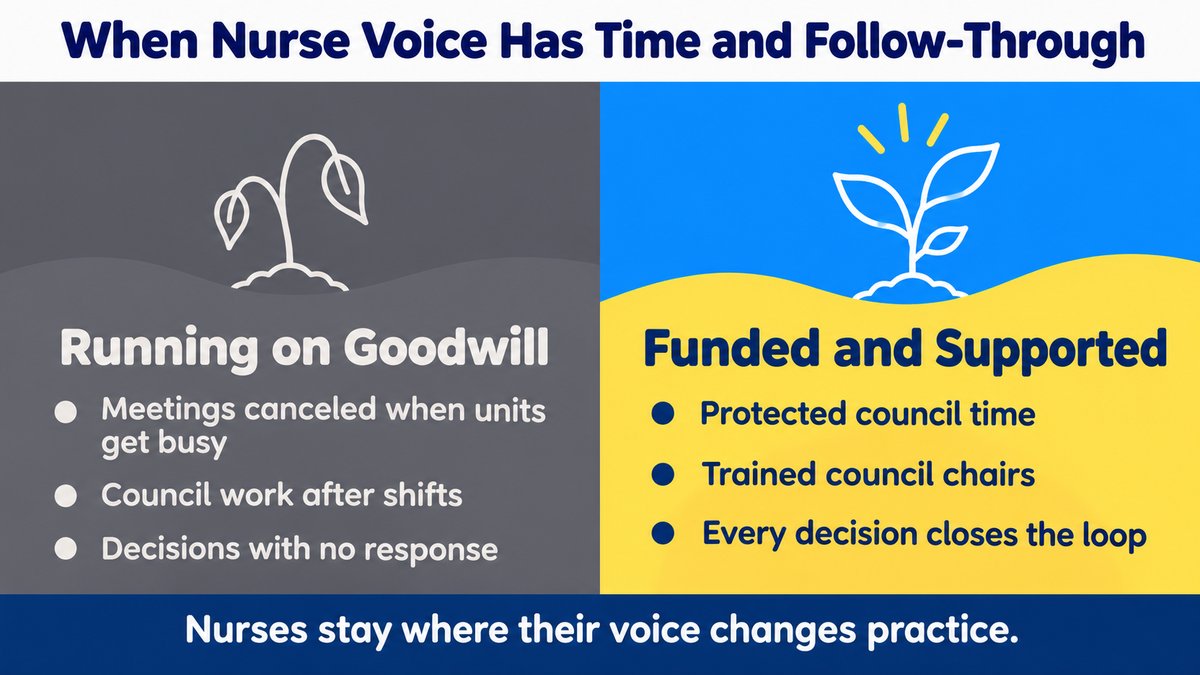
For nurses already on the team, the question is whether participation makes a difference. When council members attend on their days off, prepare outside their scheduled hours, and rarely hear what happened to their recommendations, participation can feel like another obligation.
Protected time, responsive leadership, and visible results can change that experience. Nurses are more likely to remain engaged when they see their contributions taken seriously.
The quiet cost of unfunded councils
Shared governance rarely disappears overnight. Participation gradually declines, familiar faces carry more of the responsibility, and council chairs become exhausted trying to maintain momentum.
The organizational chart may still show an active council structure, but the connection between bedside nurses and practice decisions begins to weaken. That is the gap worth addressing.
What a funded shared governance structure looks like
Imagine councils that meet as scheduled because coverage has been planned, chairs who feel prepared to lead meaningful discussions, and a clear process for bringing unit concerns forward and communicating decisions back to nurses.

That kind of structure requires more than enthusiasm. It needs practical support, including:
- Protected council time so nurses can attend meetings and prepare during paid hours, with appropriate coverage that protects patient care.
- Unit practice councils that connect bedside concerns and recommendations with hospital-wide discussions about practice, quality, and professional development.
- Council chair development that prepares nurses to facilitate discussions, guide decisions, and lead colleagues through change.
- Coordination support to organize meetings, document decisions, track follow-up, and maintain momentum between sessions.
- Communication back to the units so nurses understand what was decided, why it matters, and what happens next.
- An annual nursing assembly or retreat where councils can share accomplishments, recognize contributions, and establish future priorities.
These are tangible investments that CNOs can discuss with finance leadership. By identifying the resources each component requires, nursing leaders can move beyond a general request for support and present a clear picture of what it takes to sustain meaningful nurse participation.
Shared governance and a nursing excellence designation
For hospitals considering an investment in a nursing excellence designation, shared governance can also be an important part of the broader professional practice environment.
The ANCC Magnet Recognition Program® and Pathway to Excellence® are optional examples of designations hospitals may pursue. A hospital does not need to be pursuing either designation to benefit from supporting nurse participation in practice decisions.
For organizations already investing in a nursing excellence designation, a funded council structure can complement that investment. More importantly, it helps make shared governance something nurses experience in their daily work rather than something described only in organizational documents.
Walk the funding stack first
CFO and operating budget
Begin with the CFO and the resources already available through the operating budget.
Review how council participation is currently supported, whether nurses receive paid time for council responsibilities, how coverage is arranged, and what administrative support is available.
There may be opportunities to strengthen the structure through better scheduling, clearer priorities, or thoughtful use of existing resources. The objective is to support nursing participation without compromising patient care.
Foundation
Next, explore opportunities through the hospital Foundation.
Depending on its priorities and donor interests, the Foundation may be able to support council chair development, nursing assemblies, professional practice initiatives, or other defined needs.
The important conversation is about alignment. Which shared governance priorities fit the Foundation’s mission, and what support might reasonably be available?
Grants
Grants offer another potential funding source, particularly for leadership development, professional growth, or workforce engagement initiatives.
The key is understanding what a grant can appropriately support and whether any restrictions apply. Ongoing responsibilities, such as protected council time, may require more dependable funding than a grant can provide.
Name the gap
After reviewing the operating budget, Foundation opportunities, and grants, identify what remains unfunded.
Perhaps the hospital needs additional protected council time, more consistent chair development, or dedicated coordination support.
The clearer the gap, the easier it becomes for finance leaders and potential funding sources to understand the request. A specific need tied to nursing priorities is more actionable than a broad appeal for additional resources.
Where NEFP fits
When traditional funding sources cannot fully support the shared governance priorities, NEFP may provide another avenue to explore alongside them.
System Stream helps organizations identify opportunities to reduce expenses, recover revenue, and strengthen financial performance. Our team evaluates operating costs, enhanced employee benefits that may reduce employer payroll taxes, and recovery opportunities. We also support healthcare organizations and nonprofits through nursing excellence and fundraising programs that advance organizational priorities.
Through potential business contributions from the System Stream network, the program is designed to complement existing funding efforts and help address remaining needs associated with nursing excellence.
A few boundaries keep the model straightforward:
- An add-on, not a replacement. NEFP complements the operating budget, Foundation support, and grants. It is not intended to replace them.
- The CNO identifies shared governance priorities and the remaining funding gap. Our team manages funding discussions and coordinates the evaluation process, with the CNO providing relevant information and input as needed.
- Nursing does not become the fundraiser. Nursing leadership is not expected to organize fundraising campaigns or donor events.
- No purchase is required. Hospitals do not need to purchase or implement a System Stream solution for a nursing excellence funding request to be considered.
- The nursing funding request remains separate. If the CNO is comfortable introducing our team to the CFO, potential financial improvement opportunities can be explored in a separate conversation. Our team coordinates that evaluation with hospital finance and HR, who provide relevant information and make organizational decisions. Any enhanced benefit would be an add-on designed to work alongside existing medical plans, carriers, and renewal arrangements, not replace them. Broker or TPA involvement is optional and the hospital’s choice, with our team coordinating when requested. The nursing funding request does not depend on that discussion.
- Governance stays with nursing. Our team does not set council agendas, choose members, or direct practice decisions. Those responsibilities remain with nursing leadership and the councils.
First steps for the CNO
The CNO’s role is to establish the nursing priorities and communicate where support is needed, not to manage a separate fundraising operation.
A practical starting point is to:
- Identify which shared governance components would benefit most from additional support.
- Clarify what is already funded through the operating budget, Foundation, and grants.
- Define the remaining shortfall and the nursing outcomes that additional resources could help strengthen.
- Determine whether supplemental funding is worth exploring.
- If comfortable, introduce our team to the CFO for a separate discussion.
That introduction is simply an opportunity to explore what may be possible. It does not create a financial commitment.
Connect shared governance to your own workforce experience
The most meaningful case for funding shared governance comes from the hospital’s own nursing experience.
Rather than relying on broad statements about engagement, CNOs can examine what is happening within their organization:
- Retention patterns among nurses who participate in councils compared with those who do not.
- Council attendance and meetings canceled because of staffing demands.
- Decisions councils have influenced and how effectively those decisions were communicated to the units.
- Engagement survey and exit interview feedback about nurse voice, autonomy, and participation.
- Questions prospective nurses raise about shared decision making during recruitment.
These observations can help nursing and finance leaders understand where the structure is working and where additional support could make a difference.
When nurses see their recommendations considered, their expertise respected, and their participation supported, shared governance becomes more than a committee structure. It becomes part of the hospital’s culture and an investment in the experience of the nursing workforce.
What this path is not
This approach is not a substitute for sound operating budget decisions, Foundation support, or appropriate grant opportunities. It does not require nursing leaders to become fundraisers, and it is never about reducing the nursing team or compromising patient care to create financial room.
It is about giving an important part of the professional practice environment the support it needs.
Nurses should not have to choose between caring for patients and having a meaningful voice in how that care is delivered. When leadership makes room for both, it reinforces a simple message: your expertise matters, your participation is valued, and your ideas deserve thoughtful consideration and follow-through.
Next step
If shared governance priorities remain underfunded after exploring the operating budget, Foundation, and grants, consider Nursing Excellence Fundraising as a supplemental funding option.
To discuss your council structure, priorities, and remaining funding gap, schedule a discussion with our team.
Bring the councils you want to strengthen, the funding sources you have already explored, and a clear objective: creating an environment where nurses have the time, support, and opportunity to influence practice and build their careers at your hospital.
What would your nurses change first if their councils had the time and support to act?
MAGNET®, MAGNET RECOGNITION PROGRAM®, Pathway to Excellence and ANCC MAGNET RECOGNITION® are trademarks of the American Nurses Credentialing Center (ANCC). The products and services of System Stream, LLC are neither sponsored nor endorsed by the ANCC.
This article is for informational and educational purposes only and is not legal, financial, tax, or investment advice. Funding outcomes are not guaranteed. Nursing Excellence Fundraising Program requests are subject to evaluation and available funds. Hospitals should evaluate funding options with their own finance, legal, benefits, and compliance teams.